
It's the question almost every buyer asks before they ask anything else, and the honest answer is that it depends less on the sticker price of a home and more on the monthly number underneath it. Here's how that breaks down in today's Guelph market.


Where prices actually sit right now

Guelph is a balanced market heading into fall 2026, and prices vary a lot by property type. Condos and townhouses are averaging somewhere in the $540,000 to $620,000 range, while detached homes average closer to $780,000 to $900,000 depending on the neighbourhood and how much has been updated. That's a wide spread, which is actually good news: there's a realistic entry point at more than one budget.


What the monthly payment looks like

At roughly 4% on a five-year fixed rate (a reasonable estimate as of September 2026, though your actual rate depends on your lender and credit profile), here's what mortgage payments alone look like on a 25-year amortization:


$550,000 condo

Down payment: 10% ($55,000)

Mortgage: $495,000

Monthly payment: approx. $2,600


$650,000 townhouse

Down payment: 10% ($65,000)

Mortgage: $585,000

Monthly payment: approx. $3,080


$800,000 detached

Down payment: 20% ($160,000)

Mortgage: $640,000

Monthly payment: approx. $3,370


$900,000 detached

Down payment: 20% ($180,000)

Mortgage: $720,000

Monthly payment: approx. $3,790


Those numbers are mortgage payment only. Add property tax (Guelph's residential rate works out to roughly $1,200 to $1,500 a month on homes in this range once you include the 2026 tax increase), utilities, home insurance, and condo fees if applicable, and your realistic all-in monthly cost runs a few hundred to over a thousand dollars higher than the payment alone.


The down payment rules that actually matter

For homes under $500,000, minimum down payment is 5%. Between $500,000 and $1.5 million, it's 5% on the first $500,000 and 10% on the portion above that (so a $650,000 home needs $40,000 down, not $32,500). Above $1.5 million, you need 20% down. First-time buyers on insured mortgages can also stretch to a 30-year amortization instead of 25, which lowers the monthly payment noticeably but costs more in interest over the life of the loan.


A rough rule of thumb

Lenders generally want your total housing costs (mortgage, tax, heat, and half of any condo fees) to stay under about 39% of your gross household income, and all debts combined under about 44%. If you want a quick gut check before talking to a mortgage broker, take your gross annual household income, multiply by roughly 4 to 4.5, and that's a rough ceiling on purchase price at today's rates. It's not exact, but it gets you in the right neighbourhood.


Get the real number before you shop

These figures are meant to orient you, not replace a proper pre-approval. Rates move, your income and debts are unique to you, and a mortgage broker can tell you exactly what you qualify for within a day or two. If you'd like, I can connect you with a broker I trust, or we can talk through what price range makes sense for the neighbourhoods you're interested in.

By Wilson Li September 22, 2026
One of the things buyers ask me most often, whether they're moving from downtown Toronto or from a rural property, is what there actually is for getting outside in Guelph. The answer is more than most people expect for a city this size.  Royal Recreation Trail This is Guelph's signature trail, looping through the city along the Speed River and connecting several parks and neighbourhoods. It's paved and well-maintained, making it a favourite for walkers, runners, and cyclists alike, and it's flat enough to be genuinely accessible for most fitness levels. Speed River Trail Running along the Speed River itself, this trail offers some of the prettiest riverside walking in the city and connects toward Guelph Lake for those who want to extend a walk or ride into a longer outing. Eramosa River Trail On the city's north and east side, this trail follows the Eramosa River and tends to feel quieter and more natural than the busier central routes, a good option if you want a walk without much foot traffic. Neighbourhood parks worth knowing Beyond the river trails, Guelph has a strong network of neighbourhood parks. Riverside Park along the Speed River is a longtime favourite for families, with playgrounds and open green space. In south Guelph, Clair Park and the trails around Westminster Woods and Kortright give newer subdivisions genuine walkability. Exhibition Park near downtown is a smaller but well-used green space close to the core. Connecting further out For a longer ride or a full day out, the trail network connects toward Guelph Lake Conservation Area, which adds another 10 kilometres of trails around the reservoir, and cyclists comfortable with a longer trip can connect from the Guelph area toward the 47-kilometre Elora Cataract Trailway near Elora Gorge. Why this matters when you're house hunting Proximity to a trail or park genuinely affects day-to-day quality of life, and it's one of the first things I check when I'm helping a buyer evaluate a specific street, not just a general neighbourhood. If getting outside easily matters to you, tell me that early in the search and I'll factor it into what I show you.
By Wilson Li September 22, 2026
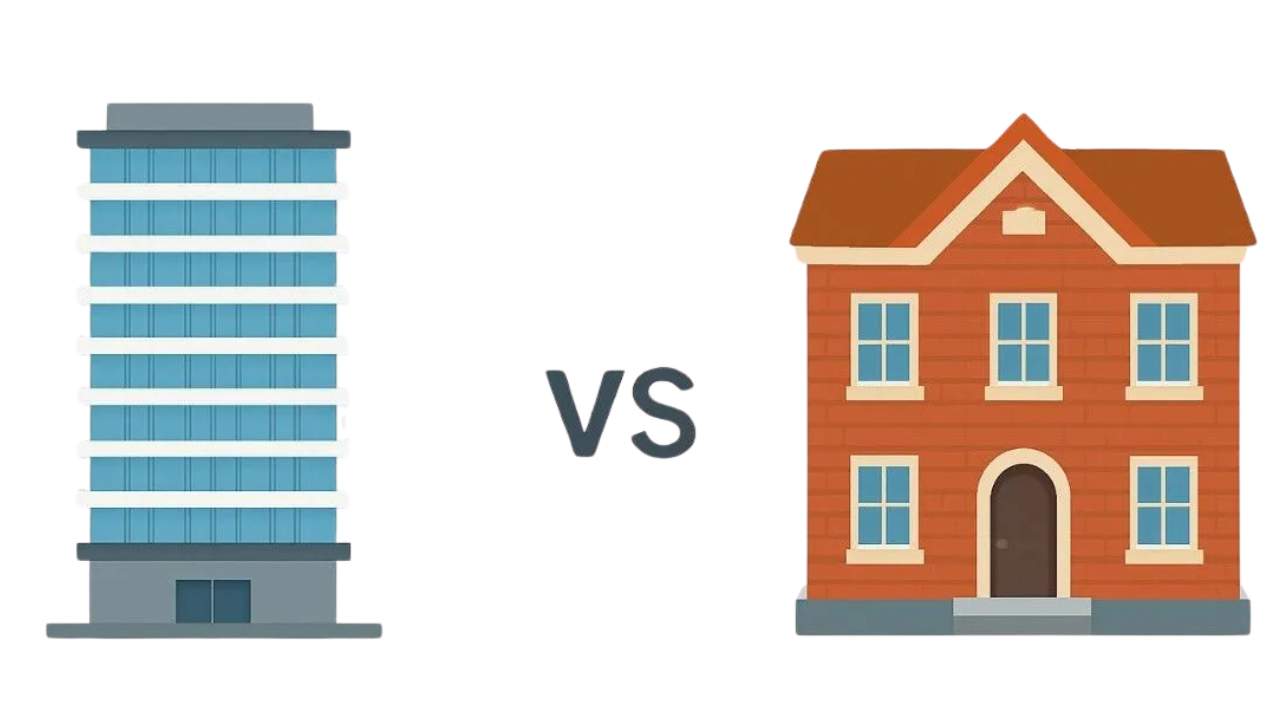
The purchase price is only part of the decision. What trips buyers up more often is the monthly cost and lifestyle trade-off they didn't fully account for. Here's how the three main property types compare in Guelph.  Condos Condos are the most affordable entry point, generally averaging in the $490,000 to $590,000 range depending on the building and location, with plenty downtown or near the University of Guelph. The appeal is low-maintenance living: exterior repairs, landscaping, and snow removal are handled through your monthly condo fee, which typically covers a share of the building's insurance and reserve fund as well. The thing to watch is the status certificate. Before you commit, it should be reviewed carefully (ideally by a lawyer) for the building's reserve fund health, any planned special assessments, and the fee history. A building with unusually low fees isn't necessarily a deal. It can mean the reserve fund is underfunded, and a special assessment down the road can run into the tens of thousands of dollars per unit. Townhouses Townhouses sit in the middle, both in price and in trade-offs. In Guelph you'll find both freehold townhomes (no condo fee, you own the land) and condo townhomes (a monthly fee that covers exterior maintenance). Condo townhomes tend to sell for roughly 20% less than an equivalent freehold townhome, since buyers and lenders price in the ongoing fee. Freehold gives you more control and no fee, but you're responsible for the whole exterior including roof and driveway. Either way, a townhouse gets you a small yard and more square footage than a comparable condo, without stepping all the way up to detached home pricing. Detached homes Detached homes offer the most space, privacy, and flexibility, and in Guelph they command the highest prices, generally from the high $700,000s into well over $1 million depending on the neighbourhood and lot. You're responsible for everything: roof, furnace, landscaping, driveway, and all repairs. There's no fee, but there's also no shared cushion when something big breaks. Detached homes also tend to hold value well and give you the most room to add value yourself, whether that's a basement apartment, a finished space, or simply renovations that suit your taste rather than a condo board's rules. Which one is right for you If low maintenance and a lower entry price matter most, a condo makes sense, especially for a first home or if you travel often. If you want more space without full exterior responsibility, a townhouse is the practical middle ground. If long-term flexibility, privacy, and the ability to add value on your own terms matter most, detached is worth stretching for if your budget allows. There's no universally right answer here, only the one that fits your budget and how you actually want to live. Happy to walk through specific listings in each category so you can see the real trade-offs side by side.
By Wilson Li September 22, 2026
Buying your first home in Guelph comes with more financial support than most people realize. Here's a plain-language rundown of the programs worth knowing about, and how they work together.  The First Home Savings Account (FHSA) This is the single best tool for most first-time buyers. You can contribute up to $8,000 a year, up to a lifetime maximum of $40,000. Contributions are tax-deductible like an RRSP, and withdrawals for a first home are completely tax-free, with no requirement to pay the money back. If you haven't opened one yet, it's worth doing even before you're ready to contribute much, since your contribution room only starts building once the account exists. The Home Buyers' Plan (HBP) Separate from the FHSA, this lets you withdraw up to $60,000 from your RRSP tax-free toward a first home. The catch is that you do have to repay it, starting the second year after you withdraw, spread over 15 years. Many buyers use the FHSA first since it never needs repaying, then top up with the HBP if they need more. A couple who are both first-time buyers can combine both programs and, between FHSA and HBP, potentially bring well over $150,000 toward a down payment. Ontario Land Transfer Tax Rebate First-time buyers in Ontario get a rebate of up to $4,000 on the provincial land transfer tax, which effectively eliminates the tax entirely on homes priced at roughly $368,000 or less, and reduces it meaningfully above that. On a $650,000 Guelph home, the land transfer tax comes to roughly $9,475, so the rebate brings your out-of-pocket cost down to about $5,475. Your lawyer handles the rebate claim at closing, so there's nothing extra you need to apply for separately. Home Buyers' Tax Credit A federal, non-refundable tax credit worth up to $1,500, claimed the year you buy. It's smaller than the other programs but it's easy money you shouldn't leave on the table. Mortgage rules that favour first-time buyers As of late 2024, first-time buyers on insured mortgages can stretch amortization to 30 years instead of the usual 25, which meaningfully lowers the monthly payment (though it does mean more interest paid over the life of the mortgage). The insured-mortgage price cap also sits at $1.5 million, up from $1 million previously, which opens up insured financing on more homes. Putting it together Here's what a real first-time buyer's stack might look like on a $650,000 Guelph townhouse: FHSA covers part of the down payment tax-free, HBP tops it up if needed, the land transfer tax rebate saves roughly $4,000 at closing, and the 30-year amortization option (if you want it) keeps the monthly payment more manageable. The programs are genuinely helpful, but timing and coordination matter. If you're a year or two out from buying, opening an FHSA today and having a mortgage broker map out your specific numbers is the best first step. I'm always happy to walk through what applies to your situation and connect you with a broker who can run the exact figures.
Show More